




July Economic Background
Global equity markets gave up ground in July, returning -1.6% after gains of 5.8% in May and 0.8% in June. Global bonds fell 1.9%, having returned 1.2% and 0.8% over the same two months, making July the first month since March in which both major asset classes declined together. Two forces pulled in the same direction: an abrupt unwinding of the artificial intelligence trade, which weighed heavily on technology and semiconductor stocks, and the collapse of the US–Iran ceasefire, which pushed Brent crude above $95 a barrel and drove UK borrowing costs above 5% for the first time since May.
Set against a longer horizon the month looks less dramatic. Global equities have returned 19.9% over the past twelve months and, despite July’s setback, have still gained 5.0% over the last three months. Fixed income has been broadly flat by comparison, returning -0.1% over the last twelve months, as sticky inflation and the prospect of higher rather than lower interest rates have kept yields elevated across developed bond markets.
Equity & Bond Performance (Last 3 Months)

Source: Morningstar (Morningstar Global Markets; Bloomberg Global Agg). Data as of 31/07/2026 in GBP terms.
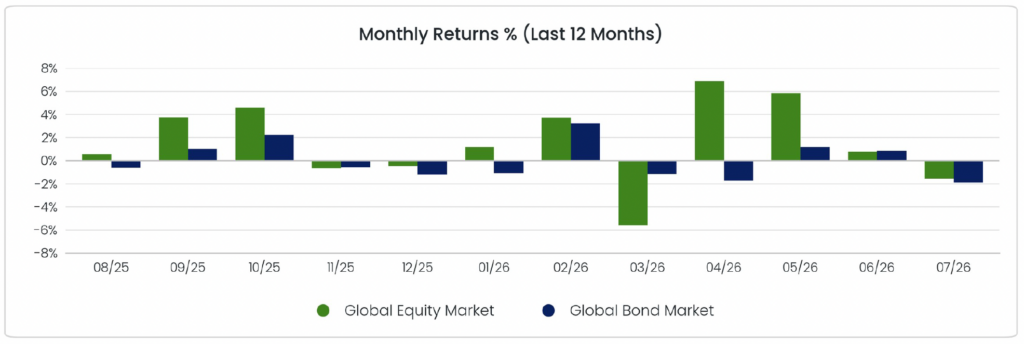
Source: Morningstar (Morningstar Global Markets; Bloomberg Global Agg). Data as of 31/07/2026 in GBP terms.
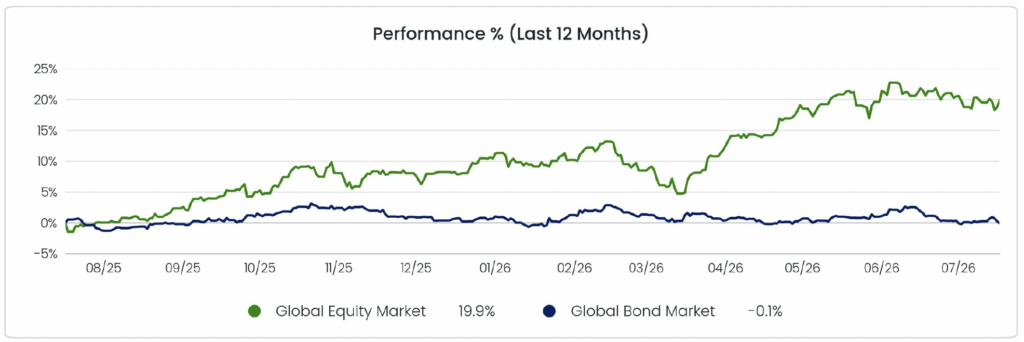
Source: Morningstar (Morningstar Global Markets; Bloomberg Global Agg). Data as of 31/07/2026 in GBP terms.
Economic Background
Gilt yields top 5% as the Bank of England holds firm
Ten-year gilt yields rose above 5% on 14th July, climbing to 5.05% after the US launched a fresh round of strikes on Iran and Tehran resumed attacks on tankers in the Strait of Hormuz. Bond prices and yields move inversely, so rising yields mean falling prices for existing bondholders. UK yields have proved more sensitive to the conflict than those of most of their European peers: the country’s energy mix leaves it particularly exposed to oil and gas prices, and inflation was already elevated when hostilities began in February. The UK now carries the highest borrowing costs in the G7, with debt interest running at more than £100 billion a year. Long-dated gilts remain the market’s weak spot, and large bond investors expect the Bank to slow or even halt its sales of long-term government debt when it sets out its quantitative tightening plans this autumn, having already trimmed the proportion of long bonds it sells in the face of softer demand.
Politics added to the pressure. Andy Burnham succeeded Sir Keir Starmer as prime minister on 20th July, with Rachel Reeves stepping down as chancellor, and gilts weakened slightly after Burnham indicated he would keep the existing fiscal rules while using any flexibility within them. His first significant announcement was an £850 million plan to remove the 5% rate of VAT on household electricity bills, worth around £45 a year to a typical household and expected to reduce CPI inflation by roughly 0.10 percentage points. There was also better news for public finances, with June borrowing of £16 billion coming in marginally below the Office for Budget Responsibility’s forecast.
Inflation retreated surprisingly, falling to a 15-month low of 2.6% in June from 2.8% in May on cheaper petrol, food, and clothing. Services inflation, watched closely as a gauge of domestic price pressure, eased to 3.6%. Economists were reluctant to read much into it: Ofgem’s price cap is set to rise 13% from July and oil spent the second half of the month back above $90 a barrel.
Against that backdrop the Monetary Policy Committee voted six to three to hold the Bank Rate at 3.75% on 30th July, while signalling that it could still need to raise borrowing costs if the renewed conflict leads to more persistent inflation. Governor Andrew Bailey said there was little evidence so far of higher energy prices spilling into the wider domestic economy but cautioned that “we cannot draw too much comfort from that at this stage.” The Bank’s central forecast has inflation rising to 3.2% by the end of the year before averaging 2.7% in 2027, with a peak of 4.5% in an adverse scenario. Two-year gilt yields fell 0.11 percentage points to 4.34% after the decision. Across the pond, the Federal Reserve had held the day before, with three of its twelve voters dissenting in favour of an immediate rise, while the European Central Bank left its deposit rate at 2.25% and signalled a possible increase in September.
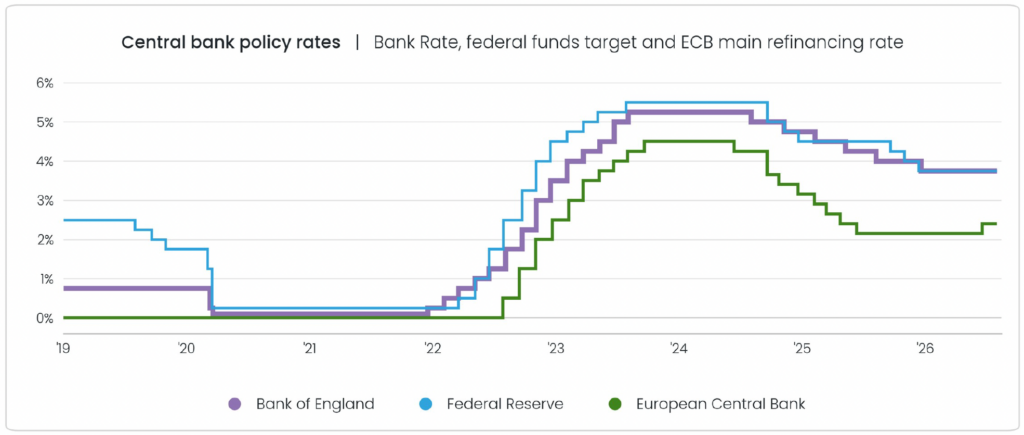
Source: Bank of England, Federal Reserve, European Central Bank. The Federal Reserve series shows the upper bound of the federal funds target range. Data as of 31/07/2026.
Oil surges past $95 as the ceasefire collapses
The Memorandum of Understanding signed in June, which extended April’s ceasefire by 60 days and was intended to reopen the Strait of Hormuz, unravelled in the first half of July. Iran resumed attacks on vessels it accused of using unauthorised routes, the US responded with strikes that ran for eleven consecutive nights from 7th July, and President Trump reimposed a naval blockade of Iranian ports. The strait, through which roughly a fifth of the world’s oil and liquefied natural gas passed before the war, is once again largely closed.
Brent crude, which had fallen from about $100 a barrel to just above $70 following the ceasefire, moved steadily higher: rising above $95 on 22nd July after Trump threatened to attack a heavily fortified underground nuclear site. That left crude roughly 30% higher over the month. Crucially, what distinguishes this episode from the spring is the absence of a buffer in the form of strategic petroleum reserves. The International Energy Agency said member countries had already released almost three-quarters of the 400 million barrels of emergency stock announced in March, leaving only a few weeks of releases before those supplies are exhausted.
The effects are being felt well beyond energy markets. US petrol prices climbed back above $4 a gallon having fallen to $3.79 earlier in the month, an awkward development for President Trump ahead of November’s midterm elections, and the easing of US inflation to 3.5% in June from a three-year high of 4.2% in May now looks unlikely to persist. Corporate earnings are showing the strain too: Ryanair reported a 34% fall in quarterly profit as its unhedged fuel costs more than doubled.
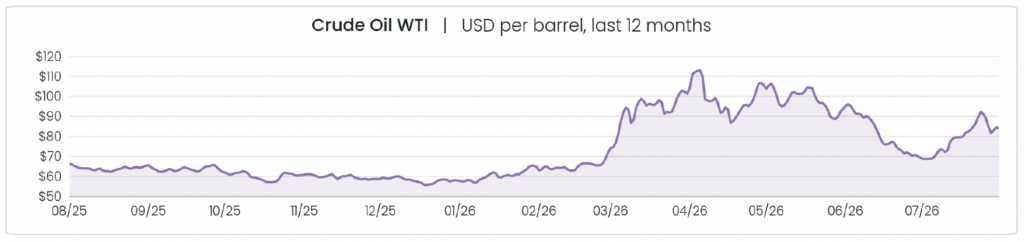
Source: tradingeconomics.com. Crude Oil WTI spot price in USD per barrel. Data as of 31/07/2026.
Yen hits a 40-year low and draws a rare joint intervention
Japan is among the most exposed of the major economies to the conflict, and its currency bore the brunt in July. Rising oil prices, and speculation that higher energy costs might force the Federal Reserve to raise rates sooner than expected, drove investors towards the dollar. The yen fell below ¥163 on 22nd July for the first time in almost 40 years, reaching its weakest level since 1986 the following day. Japan’s trade deficit unexpectedly widened to $2.5 billion in June, more than twice what analysts had forecast, underlining the vulnerability of an economy dependent on imported energy and food.
Verbal warnings had lost their force. Finance minister Satsuki Katayama repeated that authorities stood ready to act, but the yen had already broken through ¥162 earlier in the month – a level markets had treated as a line in the sand – without any response, and a ¥11.73 trillion intervention between late April and late May had been completely unwound by the start of June.
That changed on the final day of the month. In a highly unusual move, the Federal Reserve sold euros to buy yen on behalf of the US Treasury, the first time Washington has intervened to support the Japanese currency since 1998, with analysts estimating that Japanese authorities had themselves intervened the previous day to the tune of around ¥8.45 trillion ($52.8 billion). The dollar fell 1.9% on the day to ¥157.57. The Bank of Japan held its policy rate at 1%, with Governor Kazuo Ueda saying he would ensure the central bank did not fall behind the curve and could accelerate rate rises; traders now put the chance of a quarter-point increase in September at roughly 40%, up from 30% earlier in the week. Intervention buys time rather than addressing the rate differential driving the currency lower. For UK investors the practical point is a simple one: when the yen falls, the sterling value of Japanese holdings falls with it, so returns from Japan can lag the local market even while Japanese shares themselves are rising.
For financial professionals only.
Disclaimer
We do not accept any liability for any loss or damage which is incurred from you acting or not acting as a result of reading any of our publications. You acknowledge that you use the information we provide at your own risk.
Our publications do not offer investment advice and nothing in them should be construed as investment advice. Our publications provide information and education for financial advisers who have the relevant expertise to make investment decisions without advice and is not intended for individual investors.
The information we publish has been obtained from or is based on sources that we believe to be accurate and complete. Where the information consists of pricing or performance data, the data contained therein has been obtained from company reports, financial reporting services, periodicals, and other sources believed reliable. Although reasonable care has been taken, we cannot guarantee the accuracy or completeness of any information we publish. Any opinions that we publish may be wrong and may change at any time. You should always carry out your own independent verification of facts and data before making any investment decisions.
The price of shares and investments and the income derived from them can go down as well as up, and investors may not get back the amount they invested.
Past performance is not necessarily a guide to future performance.

Blog Post by Sam Startup
Investment Analyst at ebi Portfolios
What else have we been talking about?
- Q3 Market Review 2026
- September Market Review 2026
- Bond yields are rising. Here’s what that means for investors
- Investing in the megatrends changing the world
- August Market Review 2026