




Redemption pressure, weaker borrower finances and greater regulatory scrutiny have put private credit in the spotlight in 2026. ebi does not invest directly in private-credit funds, but public markets are not sealed off from the risks they bring. Here is how those risks could travel – and why the appropriate response is portfolio discipline, not prediction.
Private credit investors are discovering what happens when an asset class built for private markets meets a public loss of confidence.
For much of the past decade, direct lending appeared to solve two problems at once. Companies gained access to flexible finance without having to issue bonds or negotiate with a traditional bank. Investors received an income premium in exchange for accepting less liquidity and greater credit risk.
In 2026, the emphasis has shifted from income to the terms of liquidation. Several semi-liquid private-credit funds have received withdrawal requests above their quarterly limits. At the same time, concerns have grown around underwriting standards, borrower quality and the reliability of valuations.
The Bank of England’s July Financial Stability report was measured but clear. It said vulnerabilities in risky credit markets, including private credit, had become more pronounced, with elevated redemption requests at several retail funds underlining concerns about liquidity and valuation. It also noted that the effect on UK financial stability has so far been limited.
What this means for ebi investors
The first point is also the most important:
ebi portfolios do not hold private-credit funds directly.
ebi’s principal risk-graded portfolio suites are constructed using public-market equity and bond funds. Depending on the suite, those funds may be index-tracking, rules-based, factor-tilted or screened according to sustainability criteria.
The bond allocations are principally focused on global investment-grade markets, generally with a shorter-duration tilt. Cash Plus is a separate liquidity-focused strategy investing in sterling money-market and ultra-short-duration bond funds.
That distinction matters. If a private-credit fund marks down a loan or restricts withdrawals, the event does not translate directly into an equivalent loss or restriction within an ebi portfolio.
That does not, however, make ebi investors immune from the wider market contagion that might result in a large-scale risk event, including any that originate in private credit markets.
What private credit actually is
Private credit is lending that takes place outside the public bond markets and, in many cases, outside the traditional banking system. It is related to, but distinct from, both private equity and public credit markets.
Rather than issuing a bond that can be bought and sold by a broad group of investors, a company negotiates a loan with a private-credit manager or a small group of lenders. The lender may be an institutional fund, an insurance-backed vehicle, a business development company or an evergreen fund offering investors periodic opportunities to withdraw.
Private credit is often accessed by medium-sized companies that are too small to borrow efficiently in public markets, although the asset class now covers a much broader range of corporate, property, infrastructure and asset-backed lending.
The loans are frequently secured and commonly carry floating interest rates. Lenders may also negotiate financial covenants and other protections that are less common in public bond documentation. These features can improve a lender’s position if the borrower gets into difficulty.
But seniority and security do not eliminate credit risk. Many private-credit borrowers are highly leveraged and carry a greater risk of default. Their debt trades irregularly, and the value must often be estimated using models, comparable instruments and the manager’s judgement rather than an observable market price.
The additional yield is therefore not free money. It is compensation for some combination of borrower risk, illiquidity, complexity, leverage and valuation uncertainty.
Private credit has expanded rapidly as banks became more constrained in parts of their corporate lending after the financial crisis, while low interest rates encouraged institutional investors to search for additional income. The Financial Stability Board, an international body that monitors vulnerabilities in global finance, estimates the market between $1.5 trillion and $2 trillion.
Why the market feels different now
Private credit has not suddenly become a bad asset class. It is moving from a prolonged period of expansion into a more demanding phase in the credit cycle.
Many loans were arranged when borrowing costs were unusually low and investors were competing aggressively to deploy capital. Because private-credit loans are commonly floating-rate instruments, higher base rates fed relatively quickly into borrowers’ interest bills.
That was initially attractive for lenders: higher rates produced more income. But there is a limit to how much interest a company can service from its cash flow. When interest costs rise faster than earnings, the lender’s higher yield can become the borrower’s solvency problem.
The pressure is unlikely to be uniform. Strong businesses with manageable leverage may continue to service their debts without difficulty. Weaker companies, particularly those facing declining margins, technological disruption or refinancing needs, have less room for error.
Three features of the market now deserve particular attention:
1. More interest is being deferred
One signal of borrower stress is the use of payment-in-kind, or PIK, interest.
With an ordinary cash-pay loan, the borrower pays interest periodically. Under a PIK arrangement, some or all of the interest is added to the outstanding balance and becomes payable later.
PIK is not inherently improper or evidence of default. It may be included in the original loan terms to give a growing company greater flexibility. It can also postpone recognition of a problem. The distinction depends on whether the borrower’s underlying business is recovering or merely accumulating a larger bill.
2. Valuations depend more heavily on judgement
A lack of daily price movement can make private assets appear less volatile than listed securities. But the absence of a frequently quoted price is not the same as the absence of economic risk.
A publicly traded bond can fall sharply when investors reassess its issuer. A similar private loan may continue to be carried near its previous value until the next valuation exercise incorporates weaker performance, a comparable transaction or a restructuring.
The process inevitably involves more judgement than pricing a security in an active market.
Investors therefore need to distinguish between reported volatility and underlying risk. Smoother valuations can reflect genuinely stable cash flows. They can also reflect the fact that private assets are priced less frequently.
3. Some investors want liquidity from illiquid assets
Most traditional private-credit funds are closed-ended. Investors commit their capital for several years, allowing the manager to hold loans to maturity without having to fund regular withdrawals. In that structure, the duration of the investor’s commitment broadly matches the illiquidity of the underlying assets.
Private Credit Expansion
The chart, measured in trillions, shows the growth in exposure to private credit by region.
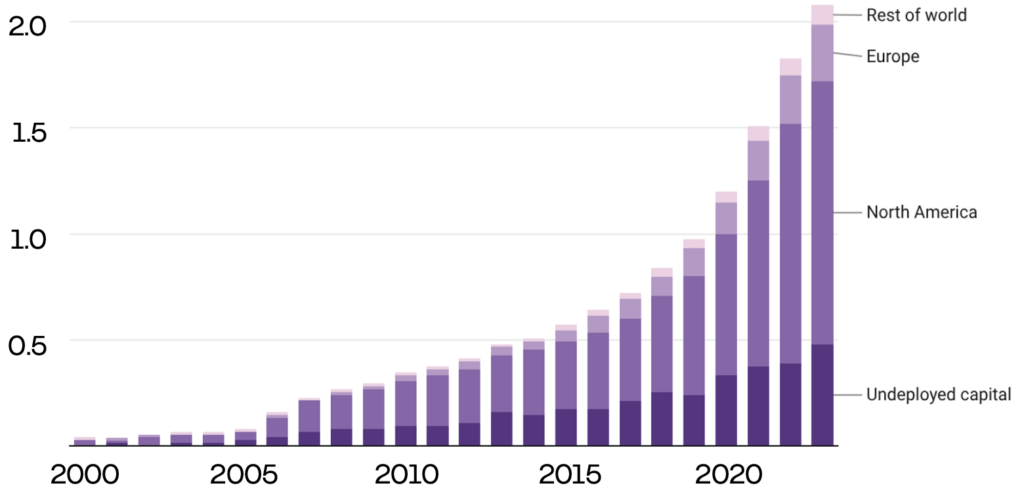
Chart: Ed van der Walt • Source: IMF, ebi • Created with Datawrapper
The more immediate concern relates to a smaller but fast-growing group of evergreen and semi-liquid vehicles. These funds invest in loans that may be difficult to sell quickly, while offering investors periodic repurchase or redemption windows.
Those offers are usually subject to limits
In the second quarter, Blackstone Private Credit Fund (BCRED) received repurchase requests equal to approximately 10% of shares outstanding. Its programme ordinarily offered quarterly repurchases of up to 5%, subject to board approval, and the fund said it would meet requests equal to that amount. Blackstone subsequently said that requests had fallen materially in the early part of the third quarter, although it cautioned that it was still early in the period. At Cliffwater Corporate Lending Fund, second-quarter requests reached approximately 17% of shares, up from about 14% in the first quarter, while the fund offered to repurchase 5%.
NOTE: A repurchase cap is not the same as a default, insolvency or an unplanned suspension. It is a contractual liquidity-management tool operating broadly as disclosed.
But there is still a practical lesson. An investor may read “quarterly liquidity” and assume that all their capital can be withdrawn every quarter. The legal terms may promise something narrower: an opportunity to submit a request, with the amount fulfilled depending on an aggregate cap and sometimes the discretion of the fund’s board.
In benign markets, that distinction attracts little attention. It becomes important when many investors ask for their money at the same time.
The Bank of England highlights that these caps can produce an awkward incentive. Investors who fear they may be unable to withdraw later may submit a request earlier than they otherwise would, adding to redemption pressure even when they have not lost confidence in the underlying loans.
Is this another 2008?
Comparisons with the global financial crisis are understandable, but they should be handled carefully.
There are similarities. Credit activity has migrated outside traditional bank lending. Some structures are complex and opaque. Leverage is present at the borrower, fund and financing-provider levels. Valuations may depend on assumptions that are difficult for an outside investor to test. Liquidity may also become least available when it is most valuable.
But the differences are substantial.
The 2008 crisis involved widespread losses on US mortgages that had been securitised, financed and distributed throughout the core banking system. Banks were highly leveraged, short-term funding was fragile and the impairment of mortgage assets threatened institutions essential to payments, deposits and the supply of credit.
Private credit is not one uniform market, and much of it is financed with longer-term institutional capital. A conventional closed-ended fund does not face the same run dynamics as a deposit-funded bank. Nor does a default by a middle-market corporate borrower have the same economic significance as a collapse in the value of mortgage collateral across an entire country.
The better conclusion is not that private credit is “the next 2008”. It is that some of the mechanisms exposed in 2008 – leverage, opacity, interconnectedness and mismatched liquidity – remain capable of amplifying losses.
The Financial Stability Board has identified deepening connections between private-credit funds, banks, insurers and private-equity firms. It has also observed that the modern private-credit market has not yet been tested through a prolonged economic downturn.
At the same time, the Bank of England’s current judgement is that the effect of recent private-credit concerns on UK financial stability has been limited. Both points can be true: there is no evidence of a systemic crisis today, but there are vulnerabilities worth monitoring.
Meanwhile, Bloomberg and the Financial Times on 20th July reported that UK pension funds and insurers are increasing exposure to private credit, sometimes as bundled assets sliced in tranches to raise their credit rating.
Why private credit is not an ebi portfolio building block
ebi’s position should not be interpreted as a prediction that private credit markets are set to fail.
Many private lenders will make sound loans, manage difficult borrowers successfully and deliver attractive returns. The asset class also performs a legitimate economic function by supplying capital where banks or public markets may be unwilling or unable to do so.
The portfolio question is different: does the asset class improve expected outcomes after allowing for fees, illiquidity, leverage, valuation uncertainty and implementation risk?
ebi hasn’t yet found the evidence sufficiently persuasive to make private credit a strategic portfolio building block. Its investment process instead emphasises transparent public-market exposure, broad diversification, disciplined construction and an evidence base that can be examined across long periods and different market environments. That may or may not change in the future and is a portfolio-design decision, not a tactical call on when the private-credit cycle will turn.
What should ebi investors do?
The most useful response is to check that the client’s portfolio remains aligned with their risk profile. Those who expect to draw on the portfolio in the near term should retain an appropriate liquidity strategy.
The Bottom Line
Private credit is facing a meaningful test. That does not make it another 2008, and it does not mean that every private loan or private-credit fund is unsound.
It does mean that investors are being reminded of three risks that can become easy to overlook when yields are attractive and markets are calm: credit risk, valuation risk and liquidity risk.
ebi’s portfolios have no direct allocation to private-credit funds. That limits exposure to private-loan write-downs and fund-level withdrawal restrictions. It does not prevent periods of volatility if stress spreads through listed financial companies, corporate bond markets or the wider economy.
The appropriate response is not to predict which borrower will fail or which fund will next apply its redemption cap. It is to know what the portfolio owns, understand where its liquidity comes from and ensure the investment strategy can be held through the periods when uncertainty is greatest.
Ed van der Walt, CFA – Assistant Portfolio Manager, ebi
Joshua Clarke, CFA – Portfolio Manager, ebi
Jonathan Griffiths, CFA – Head of Investment, ebi
For financial professionals only.
Disclaimer
We do not accept any liability for any loss or damage which is incurred from you acting or not acting as a result of reading any of our publications. You acknowledge that you use the information we provide at your own risk.
Our publications do not offer investment advice and nothing in them should be construed as investment advice. Our publications provide information and education for financial advisers who have the relevant expertise to make investment decisions without advice and is not intended for individual investors.
The information we publish has been obtained from or is based on sources that we believe to be accurate and complete. Where the information consists of pricing or performance data, the data contained therein has been obtained from company reports, financial reporting services, periodicals, and other sources believed reliable. Although reasonable care has been taken, we cannot guarantee the accuracy or completeness of any information we publish. Any opinions that we publish may be wrong and may change at any time. You should always carry out your own independent verification of facts and data before making any investment decisions.
The price of shares and investments and the income derived from them can go down as well as up, and investors may not get back the amount they invested.
Past performance is not necessarily a guide to future performance.
What else have we been talking about?
- Q3 Market Review 2026
- September Market Review 2026
- Bond yields are rising. Here’s what that means for investors
- Investing in the megatrends changing the world
- August Market Review 2026