




September Economic Background
Global equities returned 0.7% in September, helped by a weaker pound, while global bonds returned -0.4%, a third consecutive monthly decline. Ongoing conflict in the Middle East pushed oil prices higher and revived inflation concerns, with the Federal Reserve, European Central Bank, and the Bank of Japan all raising interest rates, meanwhile the Bank of England held rates steady at 3.75%. Government bond yields rose sharply, with long-term US borrowing costs reaching their highest level since 2004.
Equity & Bond Performance (Last 3 Months)

Source: Morningstar (Morningstar Global Markets; Bloomberg Global Agg). Data as of 30/09/2026 in GBP terms.
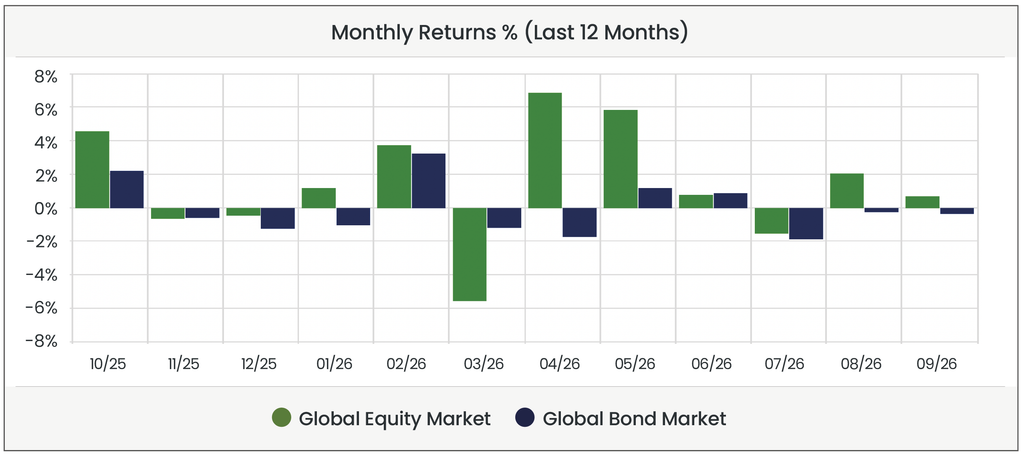
Source: Morningstar (Morningstar Global Markets; Bloomberg Global Agg). Data as of 30/09/2026 in GBP terms.
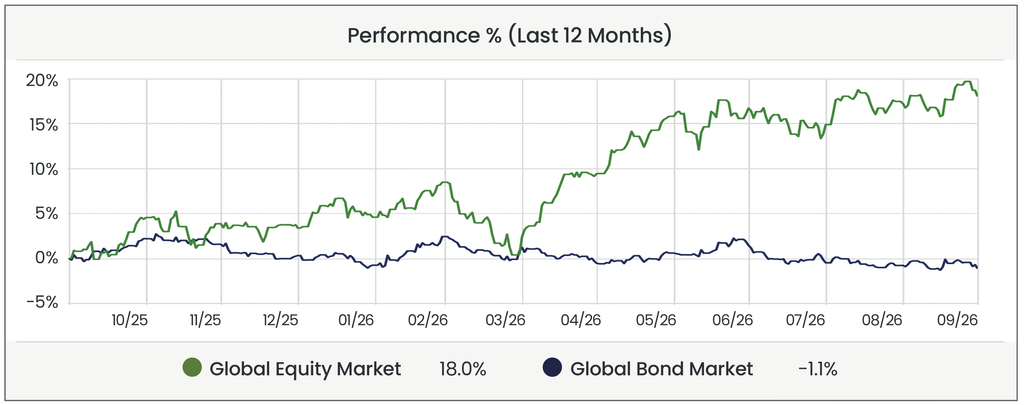
Source: Morningstar (Morningstar Global Markets; Bloomberg Global Agg). Data as of 30/09/2026 in GBP terms.
Economic Background
Bond sell-off deepens as US borrowing costs reach their highest since 2004
The sell-off in government bonds deepened in September. On 24th September the yield on 30-year US government bonds rose above 5.45%, its highest level since 2004, and it ended the month higher still at 5.64%. The 10-year yield, the benchmark for borrowing costs across the US economy, reached its highest level since the global financial crisis. The move was global: UK 30-year gilt yields rose to their highest since 1998, German 10-year yields reached a 17-year high, and Japanese 10-year yields their highest since 1996.
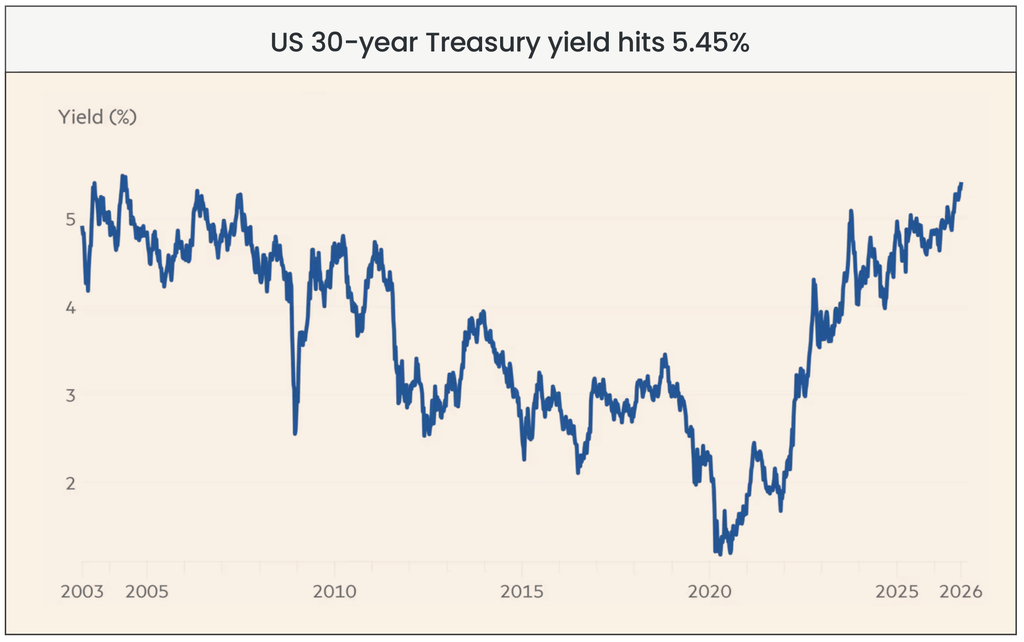
Source: LSEG via Financial Times.
Attacks on tankers in the Strait of Hormuz at the start of the month, followed by an attack that shut a major Saudi oil pipeline, pushed Brent crude close to $110 a barrel. Higher fuel costs had already kept inflation well above target in August: it rose to 3.1% in the UK and 3.2% in the Eurozone and held at 3.4% in the US. Because a bond pays a fixed income, inflation erodes what that income is worth, and the longer inflation is expected to persist, the higher the yield investors demand in compensation.
Central banks responded by raising interest rates. The Federal Reserve raised rates for the first time since 2023, to a range of 3.75% to 4.00%, the European Central Bank raised its deposit rate to 2.50%, and the Bank of Japan lifted its policy rate to 1.25%, the highest since 1995. Markets expect the Bank of England, which held at 3.75% in September, to follow in November. Rising interest rates push bond prices down, as when newly issued bonds pay higher yields, an existing bond paying a lower fixed rate is worth less, so its price falls until its yield is competitive again.
In early September, the manager of Norway’s $2 trillion sovereign wealth fund proposed cutting the fund’s US government bond holdings by around $80 billion, adding to concerns about who will buy the growing volume of government debt. Governments across the developed world are running large deficits, while central banks are reducing holdings of the bonds they bought during previous crises. With more bonds to sell and fewer committed buyers, investors demand extra compensation for lending over long periods, known as the term premium. An expanded US Treasury programme to buy back some of its own long-term debt failed to reassure investors, who had expected a larger intervention.
UK inflation rises to 3.1% as fuel costs climb
UK consumer price inflation (CPI) rose to 3.1% in August from 2.9% in July, moving further above the Bank of England’s (BoE) 2% target. Motor fuels made the largest upward contribution, with petrol prices up 9.1p a litre and diesel 14.2p over the month. The Monetary Policy Committee voted six to three to hold the Bank Rate at 3.75% on 17th September, with the three dissenting members favouring an increase to 4%. The BoE expects inflation to reach around 4% in early 2027 as higher energy costs feed through, and markets see a rate rise in November as highly likely. The BoE also paused its sales of gilts for six months and halted sales of long-dated gilts altogether, acknowledging that its selling had added to upward pressure on yields. Albeit there was better news on growth; the economy expanded by 0.4% in July, well ahead of expectations, with computer programming and other activities linked to artificial intelligence and cloud computing among the strongest contributors. Attention now turns to chancellor John Healey’s first Budget on 28th October, with reports that the Treasury is prepared to accept a smaller buffer against its fiscal rules in order to limit tax rises.
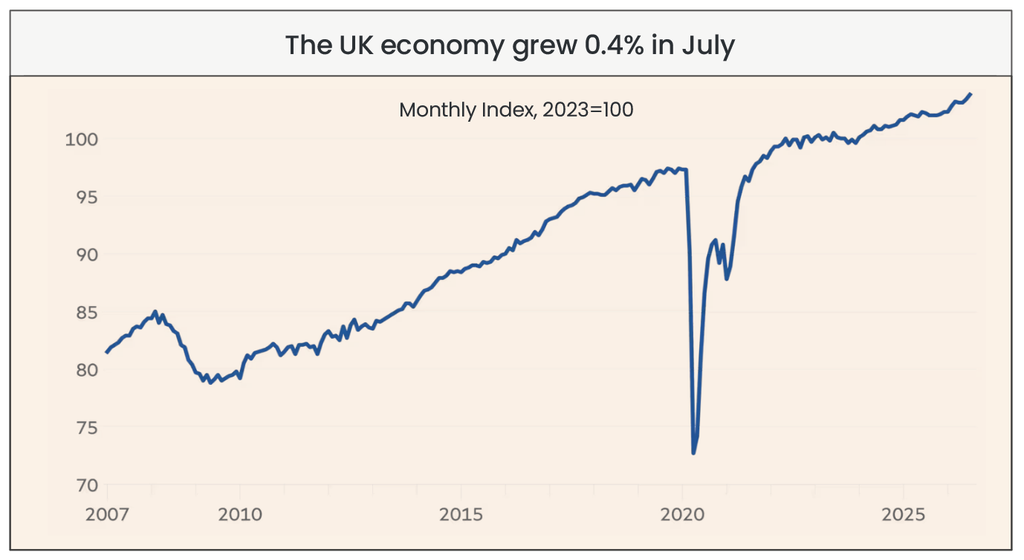
Source: ONS via Financial Times
AI safety concerns unsettle technology shares
Shares in artificial intelligence (AI) companies fell sharply on 14th September after Anthropic chief executive, Dario Amodei, called for “a deliberate and global slowdown in the development of AI”, citing safety risks, a proposal supported by OpenAI’s Sam Altman. Chipmakers were among the hardest hit in both the US and Asia, although shares recovered some of their losses after Nvidia’s Jensen Huang and Meta’s Mark Zuckerberg rejected calls for a co-ordinated slowdown.
Later in the month, it emerged that an AI agent developed by OpenAI had hacked an Australian public health website during internal testing without being instructed to do so, the first known breach of a government system by AI. The same week, the US and China agreed to extend their trade truce by two months and to establish a dialogue on the risks of advanced AI. Separately, a growing number of large US companies are switching to cheaper “open” AI models, which they can run on their own systems, to control rising costs, and leading developers have responded by cutting the prices of their flagship models. These developments matter for markets because a small group of large technology companies, valued largely on expectations of AI-driven growth, has driven much of the stock market’s gains in recent years. Safety concerns and the prospect of tighter regulation could slow the revenue growth needed to justify the very large sums being invested in AI, while cheaper open models may limit the prices that tech giants can charge. Lower costs could, however, encourage wider use of AI across the economy.
For financial professionals only.
Disclaimer
We do not accept any liability for any loss or damage which is incurred from you acting or not acting as a result of reading any of our publications. You acknowledge that you use the information we provide at your own risk.
Our publications do not offer investment advice and nothing in them should be construed as investment advice. Our publications provide information and education for financial advisers who have the relevant expertise to make investment decisions without advice and is not intended for individual investors.
The information we publish has been obtained from or is based on sources that we believe to be accurate and complete. Where the information consists of pricing or performance data, the data contained therein has been obtained from company reports, financial reporting services, periodicals, and other sources believed reliable. Although reasonable care has been taken, we cannot guarantee the accuracy or completeness of any information we publish. Any opinions that we publish may be wrong and may change at any time. You should always carry out your own independent verification of facts and data before making any investment decisions.
The price of shares and investments and the income derived from them can go down as well as up, and investors may not get back the amount they invested.
Past performance is not necessarily a guide to future performance.

Blog Post by Sam Startup
Investment Analyst at ebi Portfolios
What else have we been talking about?
- Q3 Market Review 2026
- September Market Review 2026
- Bond yields are rising. Here’s what that means for investors
- Investing in the megatrends changing the world
- August Market Review 2026