




Bond yields are rising. Here’s what that means for investors
Bond yields have surged, with the UK government forced to pay the highest borrowing cost on 30-year debt since 1998. The resulting price falls have hit some risk-averse investors particularly hard, including those in lower-risk portfolios with high allocations to longer-dated fixed income.
The sell-off is not confined to Britain. Longer-dated government bond yields have risen across major markets as investors reassess inflation and the amount of debt governments are issuing. Renewed conflict in the Middle East has sent oil sharply higher, with Brent briefly approaching $110 a barrel and remaining above $100 amid continued volatility. Longer-term pressures, from heavier public borrowing to a more fragmented global economy, are also making investors demand more compensation for tying up their money for decades.
Key overview
ㅤ
1. Long-dated government bond yields have risen across major markets as investors reassess inflation, government borrowing and the return required for lending over long periods. The move is global rather than a repeat of the UK-specific dislocation seen after the 2022 mini-Budget.
2. Duration is an important part of the risk. Longer-dated bonds are more sensitive to changes in yields, so their prices fall further when yields rise, while shorter-dated bonds are less exposed to the same moves.
3. ebi’s shorter-duration positioning means its fixed-income allocation is less exposed to rising yields than the broader bond market. In the Earth range, average effective duration was 3.79 years at 31 August, compared with around six years for a broad global bond-market benchmark.
ㅤ
At ebi, our exposure is concentrated at the shorter-dated part of the spectrum, with a current duration of around four years, meaning advisers and clients who use our portfolios have been less exposed to the pain felt by investors holding longer-dated bonds.
There may also be a deeper shift under way. For decades, long-term bond yields trended lower, eventually reaching their nadir in the era of near-zero interest rates and quantitative easing. Since then, that direction has reversed. Whether this proves to be another cycle or a more lasting change in the bond regime is still open to debate. For investors, however, there is an important counterpoint: rising yields hurt yesterday’s bondholder, while improving the returns available to tomorrow’s.
1. What is happening in bond markets and why
Among the reasons for the global sell-off in bonds is renewed inflation pressure. Conflict in the Middle East sent oil sharply higher, with Brent briefly approaching $110 a barrel and remaining above $100 amid continued volatility. Because the payments from conventional bonds are fixed in advance, higher inflation eats away at their real value, making existing bonds less attractive and pushing down their prices. The Bank of England held the Bank Rate at 3.75% in September, but three of nine policymakers voted for an increase as the Bank warned that the energy shock could keep inflation above target for longer.
The other pressure is the amount of debt governments are issuing. Public borrowing has increased in many major economies, while central banks are no longer supporting bond markets through quantitative easing. The Bank of England continues to shrink the holdings built up during that period, although it has now paused active gilt-sale auctions while it reviews how the remaining stock will be unwound. Fresh figures underline the pressure: UK public-sector borrowing was £18.3 billion in August, £3.5 billion above the OBR forecast. The market is therefore being asked to absorb a greater supply of debt, and is charging more to do so.
LONG-DATED UK GILT YIELDS FELL FOR DECADES, THEN REVERSED
Composite Bank of England nominal spot-yield series; exact published observations only.
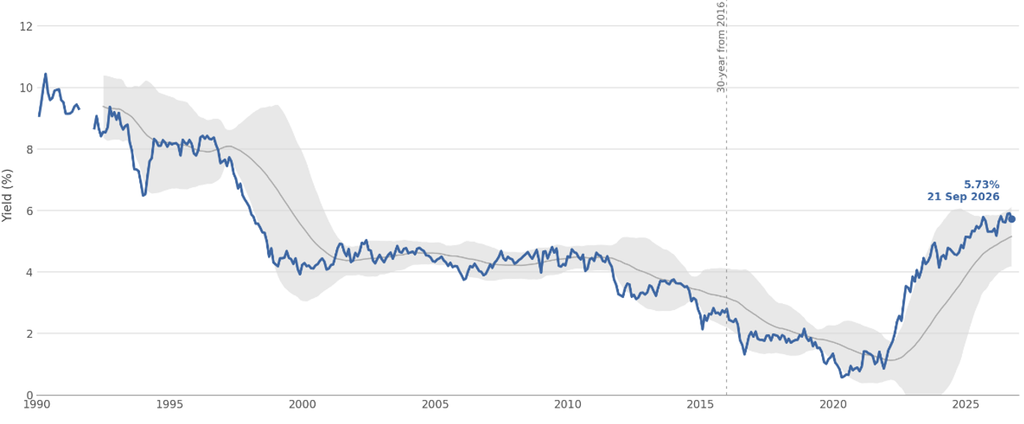
Series definition: 20-year nominal spot yield, Jan 1990-Dec 1997; 25-year, Jan 1998-Dec 2015; 30-year, Jan 2016 onward. Month-end observations through Aug 2026; latest daily observation appended for Sep 2026.
Shaded band: 36-observation rolling mean ‡ 2 standard deviations. A genuine data gap in late 1991/early 1992 is left unfilled. Source: Bank of England UK yield curve archive, ebi calculations. 22 Sep 2026.
That is where duration matters. Put simply, the longer investors have to wait to get their money back, the more a bond’s price will fall when yields rise. Longer-dated bonds therefore suffer the largest price swings, while shorter-dated bond prices fall less when yields rise.
2. Why this is different from the 2022 Truss-era dislocation
The obvious comparison is with the aftermath of the 2022 mini-Budget. Between 22 and 27 September, UK 30-year gilt yields rose by about 1.2 percentage points. Comparable US and German yields rose by only around 0.2 percentage points. The UK had abruptly separated from other major bond markets as investors questioned the credibility of the government’s fiscal plans.
This time, long-term government bond yields are rising across major economies as investors reassess inflation, public borrowing and the return they require for lending over long periods. The UK has its own fiscal pressures, but it has not experienced the same sudden, UK-specific loss of confidence seen in 2022. The current move is better understood as a global repricing of long-term borrowing costs.
3. What ebi investors actually own
At ebi, the protection element of our portfolios is invested globally rather than being concentrated in UK government bonds.
In our Earth range, the fixed-income allocation had an average effective duration of 3.79 years and an average maturity of 4.66 years at 31 August. By comparison, a broad global bond-market benchmark is around 6.0 years duration and 8.0 years maturity. In practical terms, that leaves it much less exposed to the sharp price falls seen in longer-dated bonds.
We also invest only in investment-grade debt. The Earth range currently has an average credit quality of AA, with no exposure to high-yield bonds. The protection allocation is designed to reduce risk, not add credit risk in pursuit of extra return.
EARTH RANGE FIXED-INCOME PROFILE
Designed for protection, with lower exposure to long-dated bond volatility
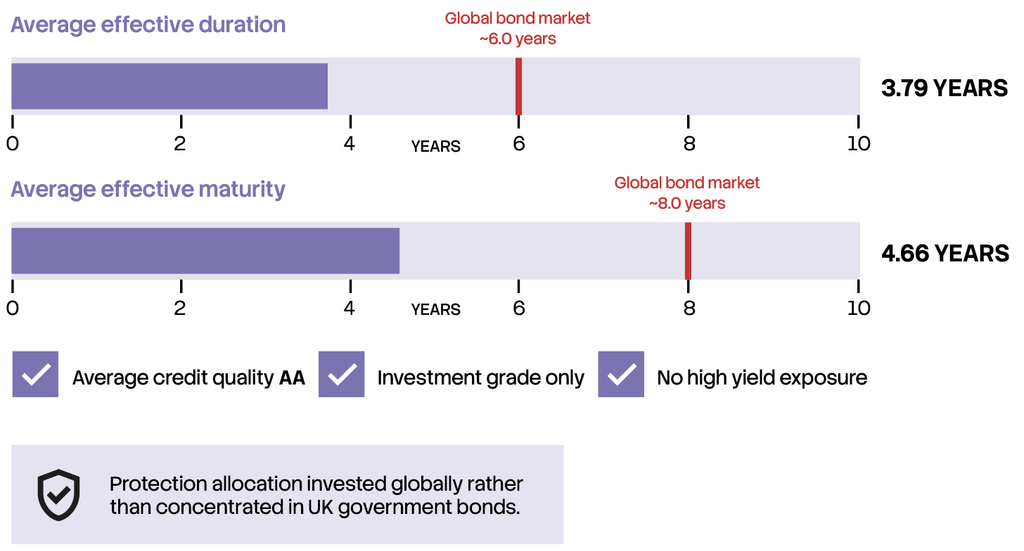
Sources: Morningstar Direct and ebi. Data as of 31/08/2026. Global bond market comparator shown as an indicative proxy based on a broad global aggregate bond benchmark as at 09/09/2026.
4. Has the long bond regime changed?
For much of the past four decades, long-term bond yields moved in one broad direction: down. Inflation became more stable, central banks gained credibility and investors grew accustomed to interest rates falling when growth weakened. Quantitative easing reinforced the trend by turning central banks into large buyers of government debt.
That era reached its extreme when interest rates approached zero and some government bonds offered negative yields. The direction has since reversed. Inflation has returned, governments are borrowing more and central banks are reducing their bond holdings rather than adding to them.
None of this means long-term yields must keep rising. They can fall when growth weakens, inflation subsides or investors seek safety. But the conditions that drove yields lower for decades can no longer be taken for granted, making the amount of interest-rate risk investors take, particularly in long-dated bonds, increasingly important.
5. Rising yields hurt yesterday’s bondholder but improve tomorrow’s expected return
There is an important counterpoint to falling bond prices. As yields rise, the return available from bonds also improves. Investors buying today are being paid more to lend than they were when yields were close to zero.
For existing investors, that benefit feeds through over time as bonds mature and money is reinvested at higher rates. The pain of rising yields is therefore felt immediately in prices, while the benefit comes later through higher income and better prospective returns.
6. What this means for advised investors
The lesson is not that bonds have become inherently more risky, but that where an investor sits in the bond market matters. Longer-dated bonds can experience substantial price swings when yields move, while shorter-dated holdings are less exposed to the same effect.
For advised investors, the key is to understand the role bonds are meant to play in the portfolio and the risks embedded in that allocation. Someone drawing money in the near term may be more sensitive to short-term losses, while an investor with a longer horizon has more time for higher yields to feed through into future returns. In a managed portfolio such as ebi’s, decisions around maturity, credit quality and geography sit within the portfolio construction rather than being choices the client needs to make themselves.
The worst response may be to react only after prices have already fallen. Selling because yields have risen can crystallise losses just as the return available from bonds has improved. The more useful question is whether the portfolio still reflects the investor’s time horizon, risk tolerance and need for protection.
The Bottom Line
ㅤ
Bond yields have risen sharply, and the effect has been most painful for investors holding longer-dated bonds. This is not simply a UK story: higher inflation, heavier government borrowing and changing central-bank policy have pushed long-term borrowing costs higher across major markets.
The key risk is duration. The further into the future a bond repays its principal, the more sensitive its price is to changes in yields. Shorter-dated bonds still move, but generally fall less when yields rise.
ebi’s fixed-income exposure is positioned towards the shorter end of the market, is globally diversified and is investment grade only. In the Earth range, average effective duration is currently 3.79 years, materially below a broad global bond-market benchmark.
Higher yields also have an upside. They hurt existing bond prices first, but improve the returns available to investors from here. The appropriate response is therefore not to react to headline moves in gilt yields, but to understand the risks already built into the portfolio and whether they remain appropriate for the investor’s time horizon and need for protection.
ㅤ
ebi’s Perspective
ㅤ
ebi’s protection allocation is positioned differently from a portfolio concentrated in long-dated UK government bonds. It is globally diversified and focused on shorter-dated fixed income. In the Earth range, the fixed-income allocation had an average effective duration of 3.79 years and average maturity of 4.66 years at 31 August, leaving it less exposed to the sharp price falls seen in longer-dated bonds. ebi also invests only in investment-grade debt, with the protection allocation designed to reduce risk rather than add credit risk in search of additional return.
ㅤ
Frequently Asked Questions
1. If bonds are supposed to provide protection, why have some investors suffered large losses?
Not all bonds carry the same risks. The key difference is duration. Longer-dated bonds are much more sensitive to changes in yields, so when yields rise their prices can fall substantially. Shorter-dated bonds are less sensitive to the same movement. The recent sell-off therefore says as much about where an investor sits in the bond market as it does about bonds generally.
2. Are ebi portfolios exposed to the same long-duration risk?
To a much lesser extent. ebi’s fixed-income exposure is concentrated towards the shorter-dated part of the market and is globally diversified rather than concentrated in UK gilts. In the Earth range, average effective duration was 3.79 years on 31 August, compared with around six years for a broad global bond-market benchmark. This means the allocation is less sensitive to sharp increases in long-term yields.
3. If yields have risen, should investors be worried about holding bonds now?
Rising yields carry two implications. They reduce the price of bonds already in issue, which creates the short-term pain investors have seen. But they also mean investors are now being paid more to lend. Over time, as existing bonds mature and proceeds are reinvested, those higher yields feed through into improved income and prospective returns. Selling only after prices have fallen can therefore crystallise losses at the same time that the return available from bonds has become more attractive.
Ed van der Walt, CFA – Assistant Portfolio Manager, ebi
Joshua Clarke, CFA – Portfolio Manager, ebi
Jonathan Griffiths, CFA – Head of Investment, ebi
For financial professionals only.
Disclaimer
We do not accept any liability for any loss or damage which is incurred from you acting or not acting as a result of reading any of our publications. You acknowledge that you use the information we provide at your own risk.
Our publications do not offer investment advice and nothing in them should be construed as investment advice. Our publications provide information and education for financial advisers who have the relevant expertise to make investment decisions without advice and is not intended for individual investors.
The information we publish has been obtained from or is based on sources that we believe to be accurate and complete. Where the information consists of pricing or performance data, the data contained therein has been obtained from company reports, financial reporting services, periodicals, and other sources believed reliable. Although reasonable care has been taken, we cannot guarantee the accuracy or completeness of any information we publish. Any opinions that we publish may be wrong and may change at any time. You should always carry out your own independent verification of facts and data before making any investment decisions.
Duration is an estimate of an investment’s sensitivity to changes in interest rates and is not a guarantee of how its value will move. Duration can change over time as market conditions, interest rates and the underlying holdings change, and actual price movements may differ from those indicated by the duration measure.
The price of shares and investments and the income derived from them can go down as well as up, and investors may not get back the amount they invested.
Past performance is not necessarily a guide to future performance.
What else have we been talking about?
- Bond yields are rising. Here’s what that means for investors
- Investing in the megatrends changing the world
- August Market Review 2026
- Private Credit Risk 2026 – Here’s what that means for investors
- July Market Review 2026