



ebi Global Factor Fund of Funds: the tax-efficient choice for GIA clients
Factor investing, ESG screening and a fund structure built with General Investment Account investors in mind. A unitised factor fund for HNW clients.
Why High Net Worth GIA clients need a different approach
Many high net worth clients hold substantial assets outside tax advantaged wrappers. Capital gains considerations, increasing concentration within global equity markets and growing demand for sustainable investment solutions can all influence investment decisions.
Advisers often need a solution that balances these competing requirements while remaining practical to implement and manage.
How the ebi Global Factor Fund of Funds is built differently
The ebi Global Factor Funds combines factor investing, integrated ESG screening and a unitised fund structure within a single multi asset solution.
The fund is designed for long term investors and may be particularly relevant for clients with significant General Investment Account holdings. It provides access to a disciplined investment process while addressing a number of challenges commonly faced by advisers and their clients.
Why Advisers Use This Fund
1. Capital Gains Tax (CGT) efficiencies by design
Unlike a model portfolio service, rebalancing happens inside the fund — so gains are sheltered from the client’s CGT position without any adviser intervention required. Tax treatment depends on individual circumstances and may change.
2. Academically grounded factor exposure
The fund tilts toward value, size, quality, momentum and minimum volatility— equity factors backed by decades of research and designed to improve long-term risk-adjusted returns beyond what a market-cap tracker can offer.
3. Integrated ESG screening
Sustainability screening is applied at the underlying fund level — structural, not optional. A clean solution for ESG conscious clients without the need for separate overlays.
4. Lower concentration in large US technology companies
The factor tilt naturally reduces exposure to US mega-cap tech. For clients already heavily weighted toward global trackers, this provides a meaningfully different return profile.
5. Irish domicile benefit
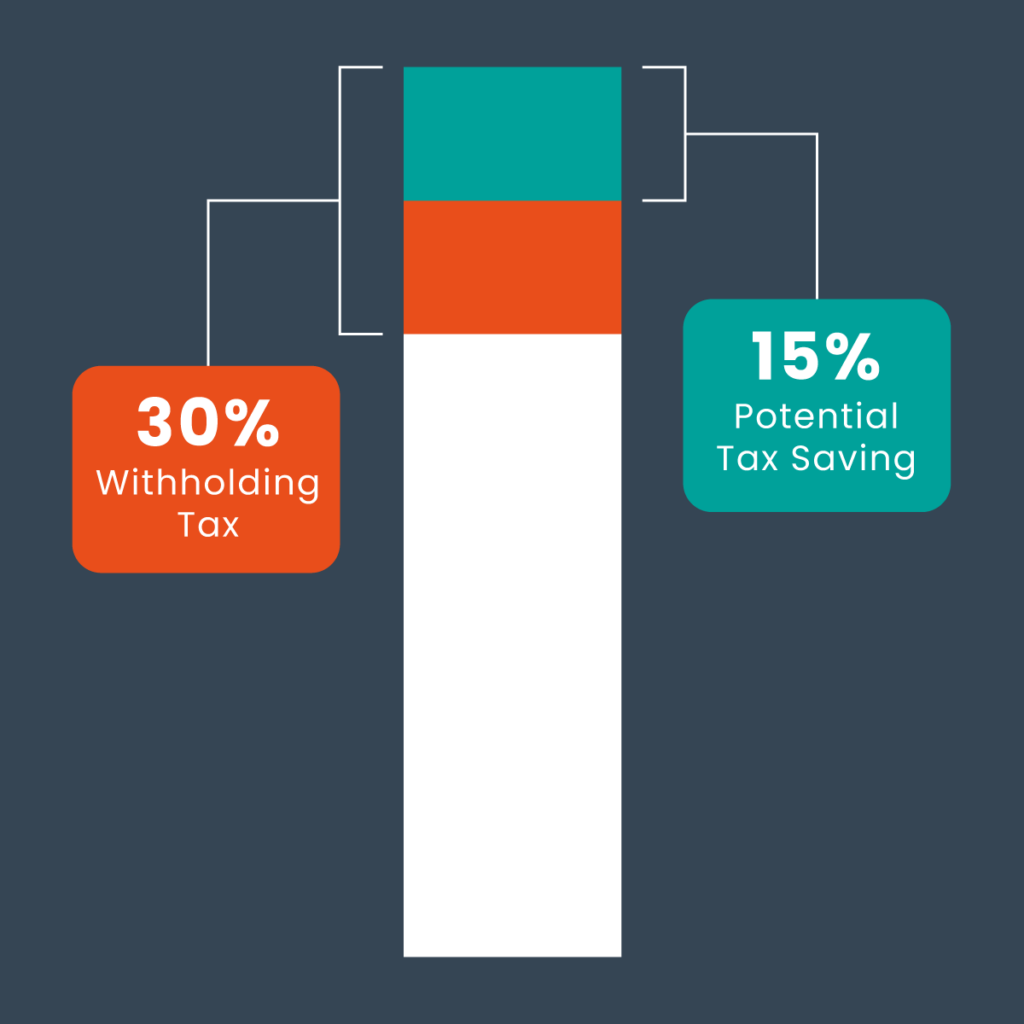
Four of the underlying equity funds are Irish domiciled, securing a reduced 15% withholding tax rate on US dividend income under the US-Ireland tax treaty, compared to the standard 30% rate. A compounding advantage built into the fund. Where US dividends are received and reinvested. This can provide an incremental return benefit over time. However, the benefit depends on the level and continuity of dividend payments and may be reduced or absent where underlying companies do not pay dividends.
Tax treatment depends on individual circumstances and may change.
6. Built on the award-winning Earth1 investment philosophy
The fund is built on ebi’s Earth1 investment philosophy — named Best Sustainable/ESG Investment Portfolio at the Investment Week Sustainable Investment Awards 2025. An evidence-based framework with industry recognition.
1. Investment Week Sustainable Investment Awards 2025, Best Sustainable/ ESG Investment Portfolio ebi’s Earth Suite
Webinar
HNW GIA Clients and the Case for a Unitised Factor Approach
Thursday 23 July 2026 | 1:00pm – 2:00pm
Join Jonathan Griffiths, CFA, Head of Investment, for a practical discussion on the role of factor investing, ESG screening and fund structure when managing high net worth clients with significant General Investment Account assets.

Learning Objectives
1. Describe how factor investing differs from traditional market capitalisation weighted investing and recognise the role of value, size, quality and momentum factors within a fund based investment approach.
2. Explain how a unitised fund of funds structure operates and understand the potential tax implications for clients investing through a General Investment Account, including the impact of Irish domicile on US dividend withholding tax.
3. Assess the implications of concentration within global equity markets and understand the rationale for using a factor based approach as an alternative to market capitalisation weighted investing.
4. Identify the client characteristics and circumstances for which the ebi Global Factor Fund of Funds may be suitable.
Structured CPD Applicable. For Financial Professionals Only.
Fund Management Team
Managed by Jonathan Griffiths, CFA, Head of Investment, and Joshua Clarke, CFA, CPIM Portfolio Manager.


Frequently Asked Questions
1. Why might I use this fund instead of a model portfolio service?
The ebi Global Factor Fund provides access to a factor-based, ESG screened investment strategy within a single unitised structure. For clients investing through a General Investment Account, advisers may find this structure offers practical implementation benefits alongside a professionally managed investment solution.
2. Why might the structure be relevant for General Investment Accounts?
Rebalancing takes place within the fund rather than at individual investor level. For clients investing through a General Investment Account, this can have tax benefits from some alternative investment structures and may simplify ongoing portfolio management. Tax treatment depends on individual circumstances and may change in future.
3. What does factor investing mean?
Factor investing targets specific company characteristics that academic research has associated with differences in long term return and risk characteristics. The fund focuses on factors including value, size, quality, momentum, and minimum volatility.
4. Why is exposure to the Magnificent Seven generally lower than in funds that passively track market-cap weighted indices?
Global Factor portfolios incorporate five investment factors, each of which favours or avoids companies with particular characteristics. The combined effect of these factors results in lower exposure to the Magnificent Seven than is typically seen in funds that passively track market-cap weighted indices.
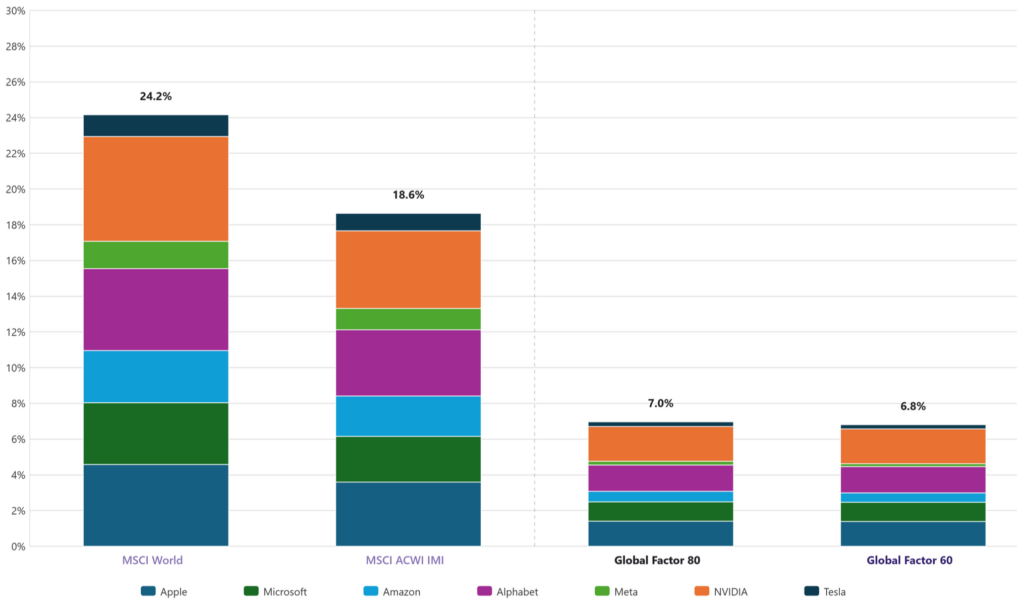
For example, the Small Cap factor increases exposure to smaller companies while reducing exposure to large and mega-cap stocks. This naturally leads to a modest underweight position in the Magnificent Seven relative to a market-cap weighted index.
It is important to note that this is an outcome of the overall factor methodology rather than an investment objective. Individual factors do not necessarily reduce exposure to the Magnificent Seven, but in this case their combined effect has resulted in lower concentration than a market-cap weighted index.
5. What is the Irish domicile benefit?
Several underlying funds held within the strategy are Irish domiciled and benefit from the US-Ireland tax treaty. This reduces the withholding tax applied to US dividend income from the standard rate of 30% to 15% — and may improve net returns over time where US dividends are received and reinvested. However, the benefit depends on the level and continuity of dividend payments and may be reduced or absent where underlying companies do not pay dividends. Tax treatment depends on individual circumstances and may change in future.
6. Does the fund use the same investment philosophy as the Earth portfolios?
Yes. The fund follows the same evidence based investment philosophy, ESG screening framework and factor-based approach used within ebi’s Earth portfolios. The key difference is that it is delivered through a unitised fund structure.
7. Who manages the fund?
The fund is overseen by Jonathan Griffiths, CFA, Head of Investment, and Joshua Clarke, CFA, CPIM, Portfolio Manager. They are responsible for fund selection, portfolio oversight, rebalancing and ongoing monitoring.
8. Which clients may be suitable?
The fund may be suitable for long term investors with significant General Investment Account assets, sustainability preferences and an interest in factor based investing. Suitability should always be assessed against a client’s individual objectives, risk profile and circumstances.
9. What are the potential drawbacks of a factor based approach?
Factor strategies can underperform broader markets for extended periods and may produce returns that differ significantly from market capitalisation weighted indices. Investors should be comfortable taking a long term view and accepting periods of relative underperformance.
10. When might this fund not be appropriate?
The fund may be less appropriate for investors seeking returns that closely track a traditional global index or those with a short investment horizon. As with any investment, advisers should consider suitability based on the client’s individual needs and objectives.
Global Factor Funds Adviser Overview
Disclaimer/ Important Information
Before recommending an investment in this fund, advisers should review the latest KIID, factsheet, prospectus and any relevant fund documentation. These documents contain important information on the fund’s investment objective, charges, risks and investor protections. Investors should ensure they understand the risks of the fund before investing.
Please note that this is an overseas fund and UK investors will not have protection under the UK Financial Services Compensation Scheme in respect of the fund.
Capital at risk. The value of investments can go down as well as up, and you may not get back the amount you invested. Past performance is not a reliable indicator of future results. Equity investments are subject to market fluctuations, which can result in significant capital losses. Bond prices are sensitive to interest rate changes. If interest rates rise, bond prices typically fall, which can result in capital losses. ESG investments, while aiming to consider environmental, social, and governance factors, may not outperform traditional investments. High-risk investments carry a greater risk of capital loss and may not be suitable for all investors. This information is for financial professionals only.
Tax laws may be subject to future change.