




There’s More to Diversification Than Buying the Index
True diversification isn’t an exercise in owning as many firms as possible. It’s making sure you’re exposed to a broad range of drivers of growth.
Diversification is a powerful tool, perhaps the most powerful one in investing. Decades of experience has shown that broad exposure through index trackers offer a low cost, transparent discipline that’s hard to beat. And it is a core principle underlying ebi’s approach to investing across our portfolio suites, from the pure market-weighted Core range to the factor aware Earth range.
The interesting development is that global equity markets have become increasingly top-heavy. The seven biggest American-listed firms: Alphabet, Amazon, Apple, Meta, Microsoft, Nvidia and Tesla, now make up close to a quarter of the value captured in developed-world stock markets. Seven eggs have come to dominate the investment basket of millions of investors. Add three more to round out the top ten, and we’ve touched above 40% of the S&P 500.
ㅤ
What’s more worrying is that several of these companies are tied to the same underlying bet: that the development of artificial intelligence will propel productivity for decades to come. It means they’re all leveraged plays on the idea that enormous spending on artificial intelligence will produce enough future profit to justify today’s valuations.
ㅤ
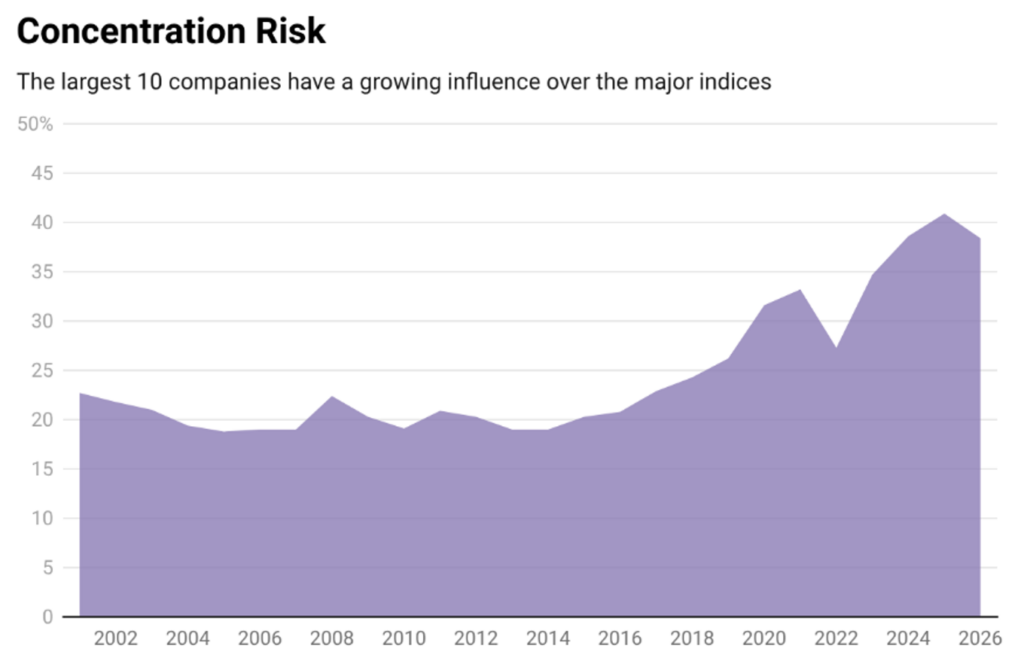
Chart shows share of S&P 500 market capitalisation accounted for by ten largest firms. 2026 Measured through June 23, 2026. Chart: Ed van der Walt • Source: ebi; FinHacker • Created with Datawrapper
The question is what happens when market leadership becomes too narrow, too expensive and too dependent on one investment story. That makes the dot-com crash of 2000 the right parallel, even for those of us not in the business of timing markets: it, too, was an era when frenzied excitement over a new technology – the internet – drove investment assumptions to extremes.
Hindsight is a wonderful thing. Looking back today at what happened in the frenzy, it’s easy to see that exuberance exceeded both fundamentals and prospects. Yet the contours of the difference between what’s happening in AI and what happened with Pets.com at the turn of the millennium will only become clear well after investment balance sheets have absorbed the reality. And while Claude and ChatGPT are still unable to predict the future, the best response remains not only broad but also smart diversification.
Proper diversification is not just a count of companies; it means making sure we’re exposed to a broad range of drivers of growth. If an investor holds 500 companies but they all sell cars, that’s a concentrated bet, not a diversified one.
And in the present case, seven names do not mean seven independent bets. Microsoft, Amazon, Alphabet and Meta are all exposed to the same risk of ballooning AI spending; Nvidia depends on chip demand from that same ecosystem; Apple is tied to the broader technology complex; and Tesla, a different prospect, but one that also partially trades partly on automation and AI optionality.
So, the index’s concentration problem is not merely that “large companies have become large”. It is that the market’s largest weights increasingly depend on a shared belief: that today’s debt-levered AI infrastructure spending will produce enough future revenue and profit to justify the capital now being committed.
And the consequence is that passive market-cap tracking has become a concentrated bet by construction.
ㅤ
The standard defence is that these companies are not Pets.com. That is true, and it matters: the largest AI-exposed firms are profitable, dominant and cash-generative in a way the dot-com casualties never were. But profitability does not by itself settle the valuation question. The biggest AI infrastructure investors could spend $700bn-plus on capital expenditure in 2026, sharply reducing free cash flow and leaving some of the world’s strongest balance sheets looking more like capital-intensive infrastructure businesses than asset-light software platforms.
ㅤㅤ
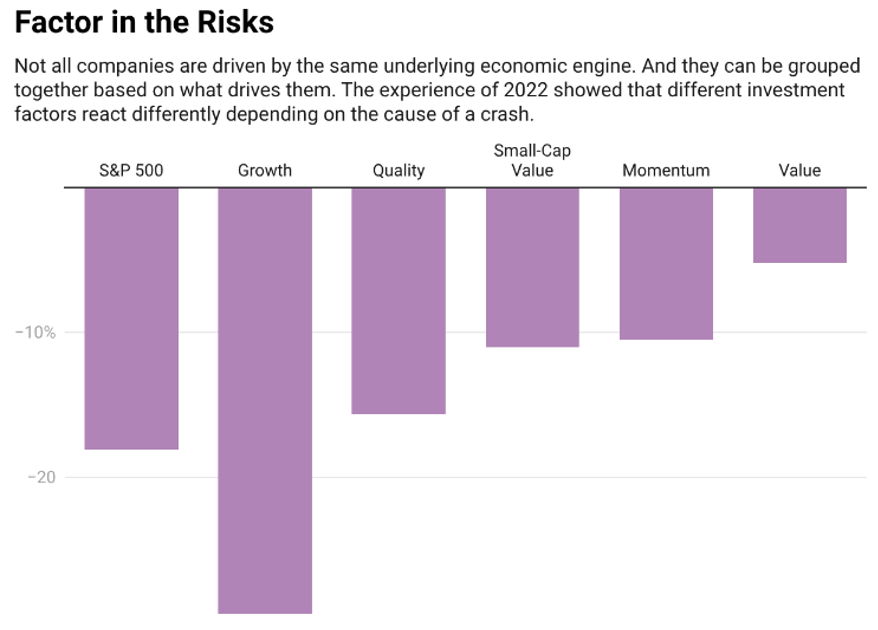
Chart: Ed van der Walt • Source: S&P 500, Morningstar,
ebi • Created with Datawrapper
It does mean the old defence “they are profitable, so the valuation is safe” is incomplete.
There is a second complication: some of the demand inside the AI system is circular. Capital moves from chipmakers, cloud providers and financial backers into AI labs, and back again through compute, chip and cloud commitments. Nvidia’s proposed investment in OpenAI is the most visible example. This is not fraud, and it is not irrational. Vendor financing has built real industries before. But it makes the demand signal harder to read. If a supplier finances a customer who then buys from that supplier, revenue can be real while the underlying end-demand stays unclear.
The most damaging lesson of the dot-com period was not that profitless internet companies could go to zero; most investors know that already. The harder lesson was that a real company, with real products, real profits and a dominant position, could still be a terrible investment if the price embedded too much optimism for the future. Cisco was not a joke; it was one of the great companies of the internet build-out. Yet its shares fell by roughly 80% from peak to trough and took decades to recover.
The risk is not that Nvidia is Pets.com. It is that Nvidia, or the broader AI infrastructure complex, proves closer to Cisco: right about the technology, but priced for a demand curve that arrives later, at lower margins, or to different owners than the equity market assumes. The shovel-seller can be the best business in the gold rush and still be the sharpest earnings casualty if the miners slow their orders.
The balance sheets are stronger than the telecom companies of 2000, the firms are genuinely profitable, and AI may yet prove more powerful than the internet itself, just as AWS required heavy investment before its economics became obvious. But none of that changes that buying the index now looks increasingly like a single, concentrated bet on an industry that has leveraged the farm on uncertain future earnings.
Ed van der Walt, CFA – Assistant Portfolio Manager, ebi
Joshua Clarke, CFA – Portfolio Manager, ebi
Jonathan Griffiths, CFA – Head of Investment, ebi
For financial professionals only.
Disclaimer
We do not accept any liability for any loss or damage which is incurred from you acting or not acting as a result of reading any of our publications. You acknowledge that you use the information we provide at your own risk.
Our publications do not offer investment advice and nothing in them should be construed as investment advice. Our publications provide information and education for financial advisers who have the relevant expertise to make investment decisions without advice and is not intended for individual investors.
The information we publish has been obtained from or is based on sources that we believe to be accurate and complete. Where the information consists of pricing or performance data, the data contained therein has been obtained from company reports, financial reporting services, periodicals, and other sources believed reliable. Although reasonable care has been taken, we cannot guarantee the accuracy or completeness of any information we publish. Any opinions that we publish may be wrong and may change at any time. You should always carry out your own independent verification of facts and data before making any investment decisions.
The price of shares and investments and the income derived from them can go down as well as up, and investors may not get back the amount they invested.
Past performance is not necessarily a guide to future performance.
What else have we been talking about?
- Q3 Market Review 2026
- September Market Review 2026
- Bond yields are rising. Here’s what that means for investors
- Investing in the megatrends changing the world
- August Market Review 2026