




Volatility in SpaceX Show IPO Rules Exist for a Reason
Wild price swings in SpaceX have served to underline just why IPO exclusion rules exist.
The company’s shares took off after listing, then came back down sharply as investors reassessed the price. It saw multiple days with percentage-point price swings in the double digits. That is not unusual. Newly listed companies often spend their first weeks and months finding a level. Some rally well beyond the offer price. Others fall back once the initial excitement fades. Many do both.
ㅤ
That matters for rules-based portfolios in a year that will see some of the biggest initial public offerings of all time.
ㅤ
Index providers are not simply deciding whether a company is big, fashionable or widely discussed. (See our earlier blog ‘Here’s what happens when a $1tn company joins the index’ here) Their rules are designed to test whether a stock is investable in practice: whether enough shares are freely available, whether there is enough liquidity, whether trading has settled, and whether the company belongs in the benchmark.
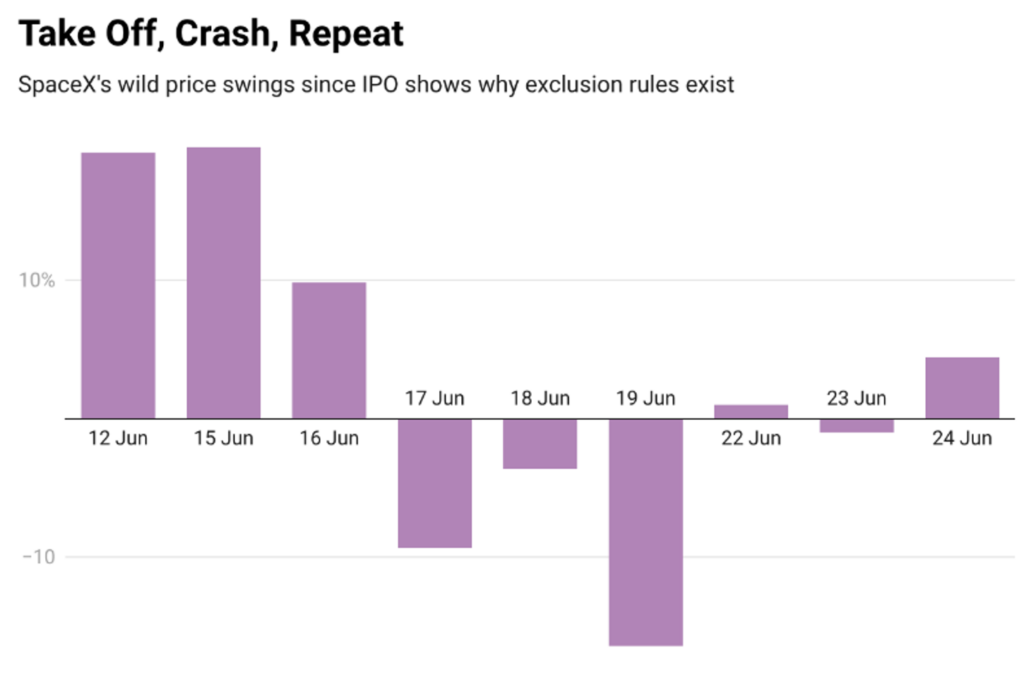
Chart: Ed van der Walt • Source: ebi, Yahoo Finance • Created with Datawrapper
This is why waiting periods, free-float tests and scheduled reviews matter. They are not bureaucracy for its own sake. They are part of the discipline that prevents short-term excitement from becoming automatic portfolio exposure.
SpaceX, OpenAI and Anthropic may all prove to be exceptional companies. But even exceptional companies need time to find a market price.
Ed van der Walt, CFA – Assistant Portfolio Manager, ebi
Joshua Clarke, CFA – Portfolio Manager, ebi
Jonathan Griffiths, CFA – Head of Investment, ebi
For financial professionals only.
Disclaimer
We do not accept any liability for any loss or damage which is incurred from you acting or not acting as a result of reading any of our publications. You acknowledge that you use the information we provide at your own risk.
Our publications do not offer investment advice and nothing in them should be construed as investment advice. Our publications provide information and education for financial advisers who have the relevant expertise to make investment decisions without advice and is not intended for individual investors.
The information we publish has been obtained from or is based on sources that we believe to be accurate and complete. Where the information consists of pricing or performance data, the data contained therein has been obtained from company reports, financial reporting services, periodicals, and other sources believed reliable. Although reasonable care has been taken, we cannot guarantee the accuracy or completeness of any information we publish. Any opinions that we publish may be wrong and may change at any time. You should always carry out your own independent verification of facts and data before making any investment decisions.
The price of shares and investments and the income derived from them can go down as well as up, and investors may not get back the amount they invested.
Past performance is not necessarily a guide to future performance.
What else have we been talking about?
- Q3 Market Review 2026
- September Market Review 2026
- Bond yields are rising. Here’s what that means for investors
- Investing in the megatrends changing the world
- August Market Review 2026